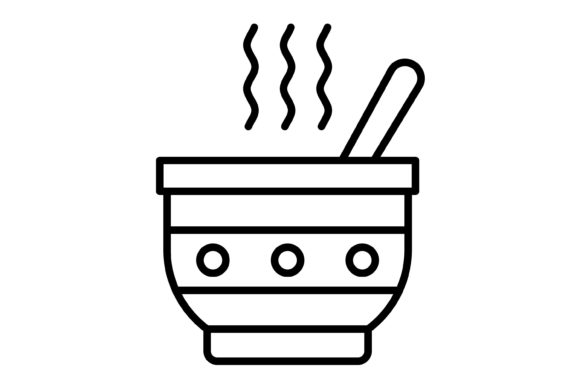
A Practical Look at the Soup Outline Icon: Formats, Flexibility, and Fit for Your Projects
In the world of digital and print design, a single, well-chosen icon can communicate a concept faster than a paragraph of text. When you need to represent food, nourishment, a recipe, or a comforting meal, the "soup" icon is a classic choice. But not all icons are created equal. The practical value of an icon lies not just in its design, but in its technical implementation and versatility. This is where a resource like the Soup Outline Icon set enters the discussion, offering a specific approach that merits a closer look for designers, developers, and content creators alike.
What Exactly is the Soup Outline Icon?
At its core, the Soup Outline Icon is a vector-based graphic depicting a bowl of soup, typically with steam rising from it. The "outline" style means it uses clean, simple lines without filled colors, often presented in a single color like black or dark gray. This minimalist aesthetic is a deliberate design choice, prioritizing clarity and adaptability over detailed illustration. It's a functional symbol designed for quick recognition across various contexts, from a restaurant's website menu to a mobile app's grocery list feature.
What makes a particular set of soup icons distinct is the combination of its visual style and its technical packaging. This specific collection provides the icon in five different file formats: AI, EPS, JPG, PNG, and SVG. This variety is a critical feature, as it directly addresses the common workflow bottlenecks designers and developers face when trying to use a single asset across multiple platforms.
Analyzing the File Format Bundle: AI, EPS, JPG, PNG, SVG
The inclusion of these five formats covers the vast majority of professional and amateur use cases, each serving a distinct purpose:
- AI and EPS: These are the master vector files. They are essential for any serious editing. If you need to change the stroke weight, adjust the curve of the steam, resize the icon to billboard proportions without losing quality, or integrate it into a larger illustration in Adobe Illustrator, these are your starting points. They offer the highest degree of control.
- SVG (Scalable Vector Graphics): This is the modern web standard for vector icons. SVGs are code-based, lightweight, and infinitely scalable. They are perfect for websites and mobile apps because they look crisp on any screen resolution, from a standard desktop monitor to a high-density smartphone display. They can also be easily animated with CSS.
- PNG (Portable Network Graphics): The mention of a transparent background is crucial here. A PNG with transparency allows the icon to be placed over any colored background or image without an unsightly white box around it. This format is a raster (pixel-based) image, so it's best used at the specific size it was exported at. It's ideal for presentations, documents, or situations where vector editing isn't possible.
- JPG (Joint Photographic Experts Group): While less common for icons due to its lack of transparency and lossy compression (which can blur edges), JPGs are universally compatible. They might be used in contexts where file size is more critical than perfect crispness or transparency, such as in certain email clients or legacy systems.
This multi-format approach is a significant strength. It eliminates the need to hunt for converters or re-export files, saving time and reducing errors in a project workflow.
Comparing Styles and Use Cases: When Outline Shines (and When It Doesn't)
The outline style of this soup icon is a specific aesthetic choice within the broader icon design landscape. It's helpful to understand where it excels and where you might consider an alternative approach.
Strengths and Best-Fit Scenarios:
- Clarity and Simplicity: Outline icons are excellent for interfaces where visual noise needs to be minimized. They communicate the idea without drawing excessive attention, making them suitable for toolbars, navigation menus, and data-heavy dashboards.
- Scalability and Responsiveness: Because they rely on clean lines, outline icons often scale down more gracefully than detailed filled icons, maintaining legibility on small screens—a key consideration for the stated suitability for mobile apps.
- Brand Consistency: The neutral style allows it to fit into a wide range of brand color schemes. You can easily change the stroke color in SVG or AI files to match a brand's primary color, ensuring visual cohesion.
- Print and Presentation: In print materials or presentations, outline icons offer a professional, modern look that complements text without overwhelming it. They reproduce well in both color and black-and-white.
Potential Tradeoffs and Considerations:
- Visual Weight: In a very colorful, dense, or playful design context, a single-color outline icon might feel too subtle or lack the desired impact. A filled, gradient, or multi-color illustration style might be more appropriate for projects aiming for a vibrant or whimsical feel, like a children's recipe app.
- Detail Limitation: The outline style is inherently minimalist. If your project requires showing specific ingredients (like chunks of chicken or vegetables) within the soup for precise communication, a more detailed icon or custom illustration would be necessary.
- Brand Personality: While versatile, the style conveys a modern, clean, and somewhat technical aesthetic. For brands that are rustic, hand-crafted, or vintage, this particular icon style might not align perfectly with their visual identity.
Making the Decision: Is This Icon Set Right for You?
Evaluating whether the Soup Outline Icon is the right resource involves matching its features to your project's specific needs and constraints. Ask yourself the following:
- What is the primary platform? If your work is heavily focused on websites and mobile apps, the inclusion of SVG and PNG (transparent) files makes this set highly practical. For print-focused work, the vector AI/EPS files are equally valuable.
- How much editing do you anticipate? If you simply need to drop an icon into a design, the pre-made JPG or PNG files might suffice. However, if you need to customize the icon's appearance, the vector source files are non-negotiable. This set provides that flexibility.
- Does the style fit your design system? Look at the other icons and visual elements in your project. Does the clean, line-based aesthetic of this soup icon complement them, or will it clash? Consistency is key in professional design.
- What is the scale of use? The claim of being "ready to use for all devices" and "easy to edit and scale" is directly tied to the vector formats. If you need the icon to appear as a 16px favicon and a 500px hero illustration, vector is the only way to guarantee quality.
In scenarios where you need a single, versatile food-related icon for a user interface, a technical document, or a template, this Soup Outline Icon is a strong contender. Its value is in its preparedness and breadth of file support. However, for a project centered entirely on food photography or requiring a very specific, illustrated style, you might explore icon libraries that offer a broader range of stylistic categories or seek out a custom illustrator.
Ultimately, the best icon resource is the one that solves your problem with the least friction. By providing a well-designed symbol in the five most essential formats, this collection positions itself as a practical tool for a wide range of creators. It acknowledges that the workflow—from concept to final implementation across different media—is just as important as the icon's visual appeal. Evaluating it against your specific project's style, platform, and technical needs will lead you to an informed choice.